When asked to define human experience, most people will reach for the senses.
Sight, which catches light and resolves it into colour, shape and distance. Hearing, which turns air pressure into music and voices. Smell, the oldest and most direct route to memory. Taste, which sorts the world into sweet, salt, sour, bitter and savoury. Touch, worked through the skin, our largest organ, reading heat, cold, pressure and texture.
This is the basic template and our industry has become very good at it. We know how to build something that looks extraordinary, sounds immersive and through curated F&B, tastes divine. We can engineer a moment that photographs beautifully.
Yet people so often walk out of technically flawless experiences feeling nothing in particular, because something else is being measured that is rarely designed for.
The opposite of belonging is fitting in
Researchers at UCLA put people inside an fMRI scanner and had them play a simple ball-tossing game. Partway through, the other players stopped passing to them. The regions that lit up were the same ones that process physical pain.
Exclusion is not a metaphor: the brain treats it as an injury.
The feeling of belonging is akin to a sixth sense, something we are continuously reading in a room, largely below conscious thought. Baumeister and Leary argued that the need to belong sits alongside food and safety as a fundamental human motivation. We arrive at every event, every space, every activation, scanning and often hoping for it.
Brené Brown’s research found that fitting in is one of the greatest barriers to belonging, asking you to assess an environment and become whatever it wants. Belonging asks you to simply be yourself.
WICKS
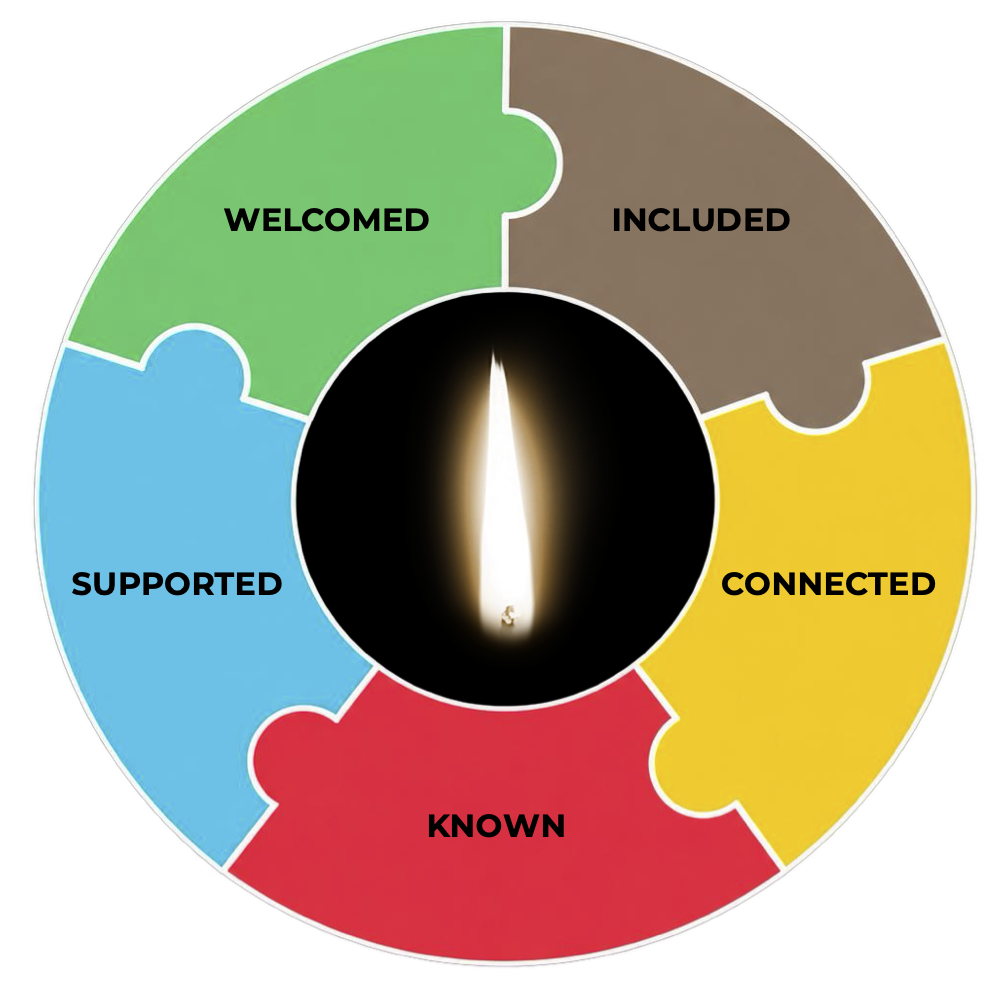
The Achievers Workforce Institute studied this across tens of thousands of people and identified five pillars, which I have reordered into something easier to remember: WICKS.
Welcomed
The feeling of belonging is often decided in the first ninety seconds. AWI found being warmly welcomed is the single most overlooked pillar, with people who feel welcomed twice as likely to feel they belong. Which means that arrival is not logistics: it’s the walk from the car, the queue, the security check, the registration desk, the person who does or does not make eye contact. It’s the very beginning of experience, the threshold where the opening verdict is set.
Included
Inclusion is the absence of an experience tax. It’s a design constraint that is practical, not philosophical. If your guest has to perform, adapt or explain themselves to fully take part, they are fitting in. Globally, a room of sixty nationalities holds people fasting, people who abstain from alcohol, people whose second language is the one you are presenting in, people who need a prayer space, people who need step-free access. Designed from the start, none of this is visible; retrofitted, it all is.
Connected
I’ve said this many times: networking is the primary reason most people attend business events. Like it or not, people don’t come to look at your stage: they come to be among other people. Design the connective tissue with the same vision as the content: who is seated where, the moments where natural pauses fall, whether the furniture layout invites conversation or forbids it. Connection cannot be scheduled into a fifteen-minute slot on a run sheet: it needs space, permission and reasons.
Known
Being recognised as a specific person, an individual who feels seen. This is where personalisation earns its name or exposes itself: a name printed on a lanyard is data, a host who knows why a specific guest has travelled to your event is recognition. The gap between the two is the difference between being processed and being known.
Supported
Nobody belongs anywhere they feel stranded or isolated. Through all stages of project delivery – pre-, live and post-experience – equip people with the tools that they need to feel supported. Plan for and mitigate any barriers before they arrive. Marcomms that answer questions before they are asked. Venue wayfinding that makes getting from A to B a breeze, not a voyage. Expert staff who solve problems instead of escalating them. Clear, quickly accessible information about what’s happening next, when and where. Support is invisible when it works and conversely, the pillar guests remember most sharply when it fails.
We are all wicks to the flame
A wick produces no light, has no heat of its own. It draws fuel steadily upward so the flame has something to burn.
The candle is the experience. The community – you, me, everybody – are the wick. In experience delivery, everything that is built – the staging, the design, the programme, the spectacle – is the visible flame. It can only burn for as long as the people in the room are fuelling it. Design a beautiful candle with no wick and you have an object that photographs well, but never catches fire.
Sensory design gets people to notice. Belonging gets them to stay, to return, to bring someone else next time, to describe the thing to other people in a way no campaign could buy. It’s what makes experience remarkable – literally, something worth making a remark about.
Build the candle. Do not forget the wick.