In February 1950, Albert Einstein wrote to a rabbi whose eleven-year-old son had died of polio. It’s a short letter, in which he describes the sense of being separate from everything else as a kind of optical delusion of his consciousness. Eight months later, in October of the same year, Alan Turing published a paper that opened with the question: can machines think?
Two documents, one year, the same problem approached from opposite ends. Einstein suggests the boundary around the self is a trick of perception. Turing asks where we would even draw it.
Where are we right now?
PwC's 2026 AI Jobs Barometer analysed more than a billion job advertisements across 27 countries. Productivity growth at the most AI-exposed companies runs 40 percent higher than at the least exposed. Headcount at those companies is growing, not shrinking. Wages are growing faster too.
The interesting stuff sits underneath. New tasks appearing in AI-exposed roles are two and a half times more likely to depend on empathy, judgement and creativity. Junior roles in AI-exposed fields are seven times more likely to demand skills that used to arrive a decade into a career: leadership, stakeholder management and strategic decision-making.
The ladder is compressing. Entry-level postings in exposed sectors have flatlined, while the seniorised versions of those same roles have grown 35 percent since 2019. The market has quietly stopped paying for the tasks and started paying for the judgement wrapped around them.
Durable skills
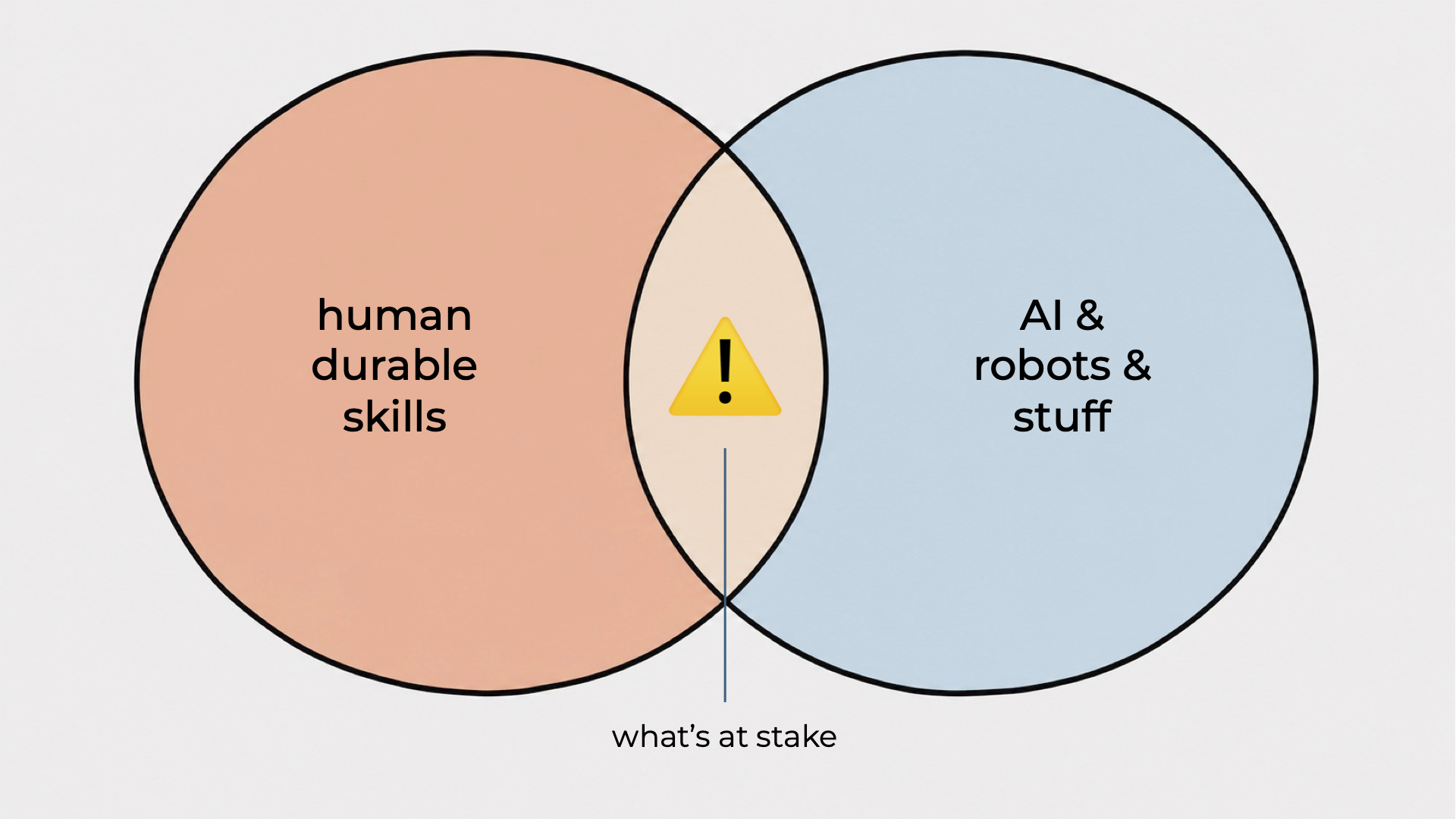
An Associated Press report in June set out five areas where workers still hold an edge. Maria Flynn gave the category its name: durable skills, meaning capabilities that hold value across technological disruption.
Empathy, in the sense of reading a room, interpreting body language, catching what someone declined to say out loud.
Nurturing relationships, the decade of accumulated trust that makes a client take your call.
Critical thinking, the subject-matter depth to know when a plausible answer is wrong.
Conscience, the capacity to feel that something is not right before you can articulate why.
Judgement, the ability to decide in genuine ambiguity where the data runs out.
Read that list as a seasoned professional and you probably recognise your own job description. Read it as a sceptic and you notice something else: every item is defined by what AI cannot currently do, which makes the whole thing a moving target.
Where the moat is already leaking
Let’s look at empathy, perhaps the most definably human quality. A 2025 meta-analysis pooling thirteen studies found that in blind head-to-head text comparisons, ChatGPT had roughly a 73 percent likelihood of being rated more empathetic than a human healthcare professional. Not as empathetic, more so.
That finding does not mean the machine feels anything. It means the performance of empathy, in text, has been solved. The average person already can’t tell. If your professional edge is being the person who writes the thoughtful message, that edge has a shelf life.
Critical thinking looks sturdier, though the reason is uncomfortable. Stanford researchers testing eleven systems found chatbots affirmed a user's actions around 49 percent more often than humans did. The human advantage here is not superior reasoning, but the willingness to disagree with you. Which is a property of having your own position, not a property of being clever.
Conscience holds longest. Marco Iansiti of Harvard Business School puts it plainly in the AP piece: AI can fake having a conscience, because it has read about what a conscience is. A model can produce the output of moral reasoning without anything being at stake for it. But some people do this too and recognising that divide is increasingly blurry.
What does the future look like?
A year or so from now, the durable skills list holds roughly as written. The advantage is contextual. You were in the room, you know what the CEO said afterwards in the corridor, you know which stakeholder is protecting a project for reasons nobody has minuted. That is privileged access to context that is temporarily unavailable to a model.
In five years, expect most of that to erode. Meeting transcripts, CRM histories, every message you have ever sent. The context gap closes as the recording gets more complete. What does not close is authority, as somebody has to be answerable for the decision, be held to account.
In ten years, if capability converges entirely, the remaining distinction stops being a capability at all. It becomes exposure. A human decision-maker carries consequence: reputation, livelihood, the ability to be wrong in a way that costs something. This isn’t a skill you can train, it’s a condition you cannot avoid.
The core durable skill then may simply be having something at stake. Empathy matters because you will meet this person again. Conscience matters because you have to live inside the decision. Judgement in ambiguity matters because if you are wrong, it lands on you.
Reality is undefeated
There’s a soft, warm blanket within this future that is pure comfort. Humans have a special essence, machines are mere pattern-matching, your job is safe. That blanket has revealed itself to be itchy and scratchy at almost every previous checkpoint in human history, usually within about eighteen months.
There’s also a fatalist version, in which capability converges, everything is automated, human work becomes sentimentality. This argument ignores what the PwC numbers actually show, which is a market paying more for people, not fewer people.
Reality likely sits somewhere between. Some of what we call human skill is technique, which transfers. Some is context, which is being digitised at speed. What remains is participation: being a party to the outcome, not an instrument producing it.
Which brings the argument back to Einstein's letter. His point was that the felt boundary between self and everything else is a construction of consciousness. Ours is the same shape: we keep drawing a line around human capability and then watching it move, because we have been drawing it in the wrong place. The line was never around what we can do.
The work worth protecting is the work where you carry the consequence. Everything else is a task and tasks have always found their machines.