Ask a delegate when they decided to attend your event and they will tell you about the moment that they registered.
They are almost certainly wrong. The decision was made somewhere else, weeks earlier, in a series of moments you never saw, most of which had nothing to do with your marketing.
A framework worth revisiting
In 2005, Procter & Gamble CEO A.G. Lafley identified two moments of truth. The first is the encounter with the product, decided in just a few seconds. The second is the experience of using it. An important third was added later: the moment the customer tells other people.
In 2011, Google inserted one key moment before all of them: the Zero Moment of Truth (ZMOT). This is the research phase, where the stimulus lands, where the person picks up a phone. Google's study found the average shopper consulted more than ten sources, roughly double the previous year. Long before they engage with you they have already decided, even if they’re unaware of it themselves.
Fifteen years on, the mechanics have changed completely while the principle has held. The number of sources is higher and the sources themselves are different, but the sequence remains the same.
Why this matters more for experiences than products
Google found that travel was influenced by ZMOT in 99 percent of cases, with one of the longest decision cycles of any sector measured. Attending an event sits closer to travel than basic product purchase. A delegate is not buying a thing, they are committing time out of a working week: a flight, a hotel, a budget line somebody has to approve, all of which is underwritten by their professional reputation with whoever signs it off. That decision does not happen in seconds. It happens over weeks, mostly in private, mostly without you.
Flash forward to the present and there’s a new urgency to this decision-making process that needs your attention. Freeman's end of year trends recap found around half the events it tracked ran behind their normal registration pace across 2025. Its April 2026 report found 70 percent of attendees rank in-person events as their top source of professional learning, ahead of every digital alternative. Freeman's own advice is to stop fighting for earlier commitment and design for the later curve.
This isn’t a demand problem: the gap between wanting to go and committing to go has widened. That gap is where every moment of truth now lives.
The moment before zero
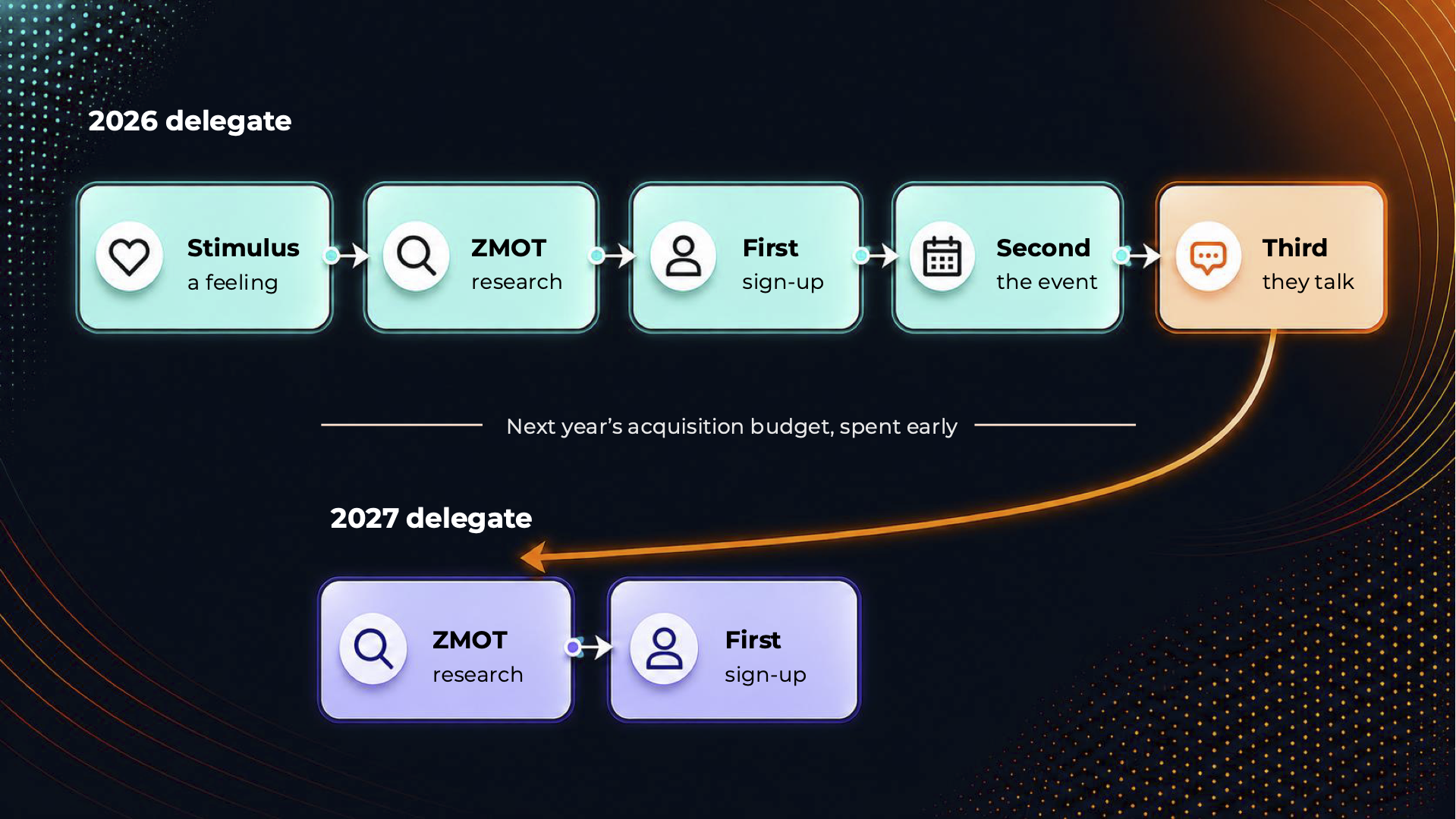
ZMOT begins with a stimulus, which presupposes a need already exists to be triggered. For experiences, this is where the model quietly assumes too much. But that is rarely how it begins. The need to attend an experience starts as a feeling. A vague sense that this year should be different, that the network has gone stale, that something is being missed. The whole FOMO thing.
Research on decision-making has suggested for decades that measurable brain activity precedes our conscious awareness of having chosen. The direction is uncomfortable and familiar: by the time we notice we are deciding, something has already begun.
Which means there is a vital stage before the zero moment, when the delegate is not searching for you because they do not yet know there is anything to search for. Most event marketing begins 8-12 weeks out, which is both typical and fundamentally late. At this point, the pre-zero moment has already been decided. What determines whether you exist at that stage is whether you were present during the preceding months when nobody was looking.
Where clients and agencies can actually intervene
Before the search even starts, publish continuously, not seasonally. Last year's session recordings, the speaker interviews, the research nobody else in your sector is producing. Consider this, everything, as your platform, not just the end game, the final isolated experience. This is the least glamorous line in any event budget and the one that decides who gets searched for at all.
At the zero moment, assume the delegate is looking at ten sources, only two of which you control. So audit what a search actually returns three months out. If the answer is a holding page with a date on it, you have surrendered the moment that decides everything. Name your speakers early, publish the agenda before you feel ready, show last year's room, honestly, including how full it was.
Then remember what they are really searching for. Executives consistently report asking who else is attending before asking what the topic is, which is the same finding that makes networking the primary reason most people attend. Peer recommendation outranks every other input in B2B decisions. If your ZMOT presence answers the programme question while ignoring the room question, your positioning is askew.
The first moment is your registration page and your arrival. Both are quick decisions, judgements made in a few seconds. A form that asks fourteen questions is a moment of truth, one that is failing.
The second moment is the experience itself, the part our industry already takes seriously. This is where belonging does the work, because it is the only moment where you cannot fake anything.
When we reach the third moment, people will talk about it regardless, the only variable is whether you gave them something specific to say, ideally something remarkable. A branded photo wall generates a photograph. A genuinely surprising moment generates a sentence or a paragraph. Words travel further.
The force multiplier that compounds
This is the mechanism that makes all of it worth the effort. The third moment of truth becomes somebody else's zero moment. Your guest posts about the experience and that post is now one of the sources in the ten that the next delegate consults. Their conversation with colleagues in the office on Monday morning is another. The cycle does not end at the event: it reloads.
All of this reframes the purpose and ‘so what?’ test of post-event content. An experience highlight film is not a thank-you to the client: it’s next year's acquisition budget, spent early, in the only currency that the zero moment accepts, which is someone other than you saying it was worth going.
The moments you cannot see
Everything expensive in the experience industry happens in the moments we can watch: the build, the show, the room. Everything decisive happens in the moments we can’t see: a delegate scrolling on a Tuesday evening, a colleague's offhand remark, a search result from a conference two years ago. You cannot control those moments. You can be present in them, or absent from them. Absence is a choice many organisations make without noticing.
The work is not persuading people at the point of decision, because by then it’s already been made. The work is being findable, credible and talked about during the long, quiet stretch of moments when nobody has yet decided anything.