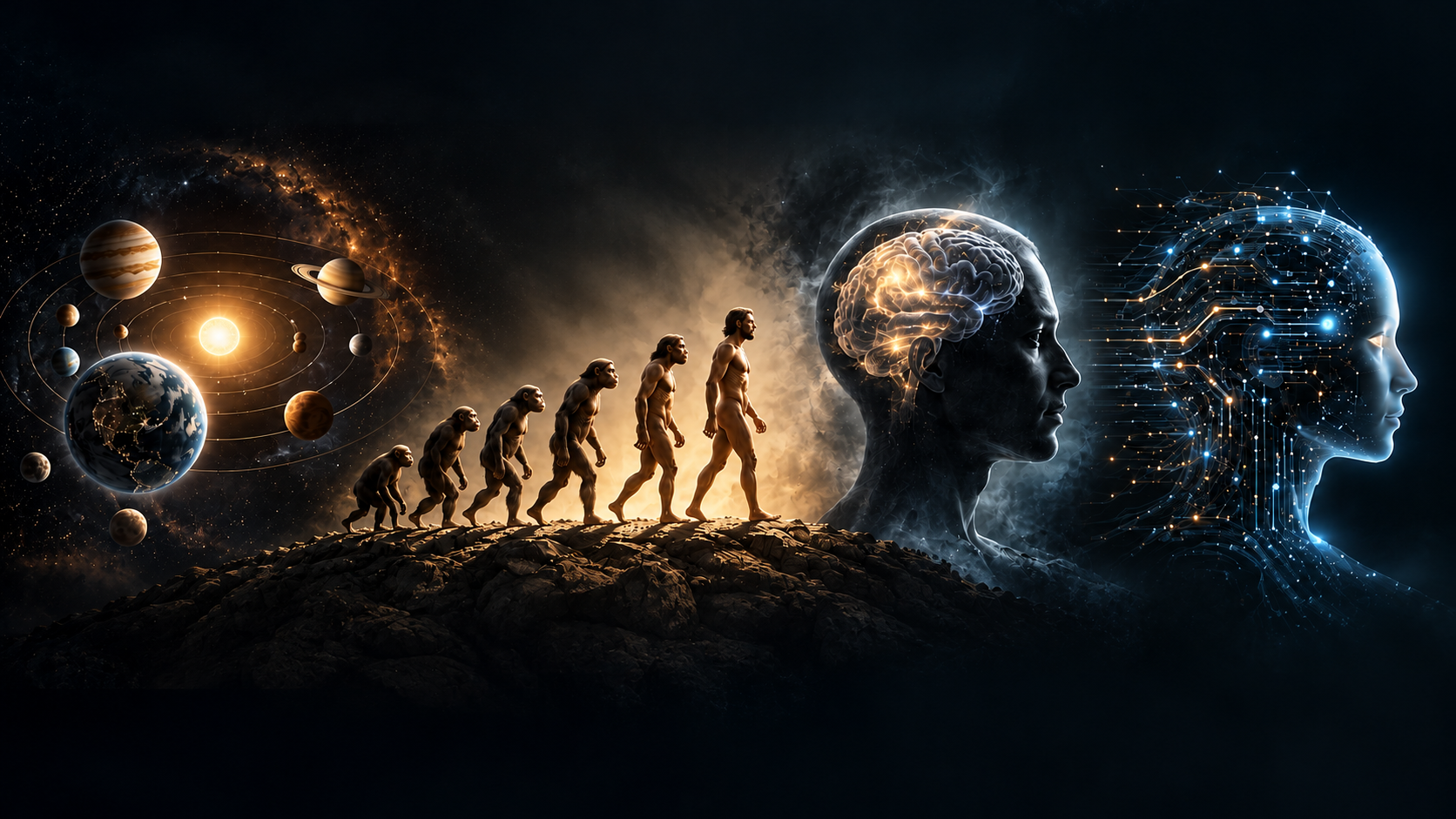
In 1917, Sigmund Freud wrote a short essay about wounds.
Not in the physical sense: wounds to our self-regard, when science tells us something we would rather not hear. He counted three such blows, each one delivered to what he called our naive self-love.
The first was cosmological. Copernicus moved the Earth out of the centre of the universe and made it one body among many, tracing an orbit around a star that has no particular interest in us. The second was biological. Darwin ended the idea of humanity as a separate creation, placing us instead inside the animal kingdom with a shared ancestry we did not choose. The third, Freud himself proposed, was psychological: we are not even masters of our own minds, since much of what drives us operates below the level of anything we can inspect.
Read the essay today and there is something almost comic in the confidence of it. Two giants of science, then Freud, holding the door open for himself, a self-nomination which has largely stuck. Many people have since tried to name the fourth.
The fourth has been claimed before
In 1993, the historian Bruce Mazlish published The Fourth Discontinuity, arguing that the line we draw between humans and machines had become intellectually indefensible. We had already surrendered our separateness from the cosmos, from animals, from our own reason. The last wall standing was the one between us and the things we build. Mazlish thought it was coming down.
In 2014, the philosopher Luciano Floridi made a version of the same case in The Fourth Revolution. His candidate was Alan Turing. His claim was informational: we have lost our position as the undisputed centre of the world of information, the only things that process, store and act on it.
John Searle reviewed the book and suggested, waspishly, that Floridi seemed to see himself as the successor to Copernicus, Darwin and Freud. Floridi pointed out that he had credited Turing. The exchange is instructive: announce a fourth humiliation and someone will assume you are applying for a place on the list.
Then in 2024, a group of psychiatrists writing in Frontiers in Psychiatry proposed generative AI as a fourth narcissistic blow with a much narrower definition. Theirs is linguistic. Language, they argued, was the last domain we held exclusively: the medium of thought and relationship.
We now share it.
Three serious attempts, three decades apart, converging on roughly the same territory. The convergence is the argument's strength. It means the ground has been shifting for far longer than the last three years of headlines suggest.
It also tells us which version to take seriously. The popular framing is cognitive: machines can now think, so our monopoly on intelligence is finished. That framing collapses under the slightest pressure. Machines beat us at arithmetic in the 1940s. A computer took the world chess championship in 1997. Neither event produced a crisis, because we simply reclassified the skill. Calculation stopped counting as intelligence the moment a machine could do it. Chess became pattern recognition instead of genius. We have been quietly moving the goalposts for eighty years.
The psychiatrists are sharper. The recent change was articulacy. A machine became able to produce a condolence letter, an argument, a poem, a strategy document. Language was where we kept the receipts for our own interiority, because the evidence that someone was in there was that they could tell you about it.
Now something can tell you about it with nothing in there at all.
A toddler still beats the bar exam
In 1988, the roboticist Hans Moravec noticed something odd. As he put it, it is comparatively easy to make computers exhibit adult level performance on intelligence tests or playing checkers, while it is difficult or impossible to give them the skills of a one-year-old when it comes to perception and mobility. This became known as Moravec's paradox, which has held up well. We have models that pass the bar exam. We have no robot that can reliably fold laundry.
Moravec's explanation was evolutionary. Sensorimotor skill has hundreds of millions of years of optimisation behind it, refined across every ancestor that ever caught food or avoided being caught. Deliberate abstract reasoning is perhaps a hundred thousand years old. He described it as the thinnest veneer of human thought, useful mainly because it rests on far older and more powerful sensory and motor knowledge.
The implication inverts every hierarchy we have built. The thing we were proudest of, the thing we put at the summit of human worth, the thing we constructed entire education systems and professional classes around, fell first because it is the newest and shallowest thing we do.
We had mistaken the scaffolding for the summit.
Some researchers, including Arvind Narayanan, argue the paradox reflects what the field chose to work on as much as what is intrinsically hard. Fair enough. The inversion stands regardless of cause: the capacities we treated as our crowning achievement turned out to be the ones most easily reproduced, while a toddler's grip on a cup remains out of reach.
What we are still better at
From here the argument splits and where you land says a good deal about what you believe a person is for.
One reading is a loss of purpose. For millennia we found deep meaning in mastery: in learning to paint, to diagnose, to write, to build an argument that holds. If a machine does these instantly and better, the motivation to strive is undermined at the root. As systems become better at optimal decisions in medicine, law and governance, we may hand over agency willingly and find ourselves passengers in a world that is being arranged by something else. If intelligence was our great adaptation, being outclassed makes it feel redundant.
The other reading treats this as a useful subtraction. AI demonstrates that you can have extraordinary capability with no subjective experience whatsoever: no joy, no grief, no stake in the outcome. That separation is clarifying. It suggests our value came from something other than being a bio-calculator. A perfectly written sympathy letter means something only because a person chose to write it, with all the awkwardness that involves. Some of this is already visible in the labour market, where the skills holding their value are largely the ones that were never really about processing information. Relieved of being the sole engine of intellectual production, we might shift from a culture organised around utility to one organised around experience.
The second reading is the more useful of the two. Both share a flaw, though: each assumes the question is what we are still better at. Three previous humiliations should have taught us to abandon that question entirely, because none of them resolved by finding a new thing humanity was best at.
What Copernicus gave back
Each blow landed the same way. Copernicus removed us from the centre of the universe. What we received was astronomy, plus a cosmos vastly more interesting than the one we lost. Darwin removed our separate creation. What we received was biology, medicine, genetics, plus a kinship with every living thing, which beats sovereignty over them by some distance. Freud removed the notion that we govern our own minds. What we received was a century of psychology and the beginnings of a serious account of why people do what they do.
Each humiliation took away something false. Each returned something truer.
So the useful question is what false thing this one is removing. My answer: the belief that human worth is a function of human output.
It is a recent belief, historically speaking, though it is deeply embedded now. We introduce ourselves by our jobs. We rank children by what they can produce under exam conditions. We describe people as high performers as though performance were the person. Freud's third humiliation put us at a remove from our own minds. The fourth goes further, suggesting the part of us we had chosen to measure was never the part that mattered.
If that is right, what AI is taking is not our intelligence, it is our excuse. We spent a century using productivity as a proxy for value, because the proxy was easy to measure while the real thing resisted it. That proxy is now being automated. What remains is the question we were avoiding all along: what a person is worth once you subtract what they make.
So try the subtraction yourself. If every output you produce could be produced by something else tomorrow, what is left of you? Not your job title, not your portfolio, not the work you have signed. What is actually there when you remove everything you would put on a CV?
Most people, asked honestly, find the list shorter than they expected. Some find it longer.
The same exercise works at the scale of the species. Copernicus was right, so you are standing on a rock in an unremarkable orbit. Darwin was right, so you are an animal with a talent for abstraction. Freud was at least partly right, so the animal runs on impulses you did not authorise. Now a machine writes your emails better than you do.
Strip all four away and something is still sitting there reading this sentence. Something that can be moved by a piece of music, that will grieve for people it has lost, that is capable of choosing to be kind when nothing enforces it.
Four times now we have been told we are less central than we assumed. Four times what we lost was a story we told about ourselves, while the thing the story described survived intact.
Which makes all of this a failure of measurement. We spent a century counting what we produced and calling it a person.