Establish, Expand, Lead: A Brand Framework For Legacy Building
Almost every brief asks for twelve months, with good intentions. Budgets run in financial years and procurement approves what it can defend. The person writing the brief sometimes may not know whether they will still hold the role in eighteen months, so committing beyond that feels like overreach.
The result is that most proposals answer the question as written. Twelve months in, twelve months out, a wrap report, then everyone starts again from a standing position.
I have written before that strategy asks a different question to planning. Planning answers the brief, strategy asks where this goes after year one. The structure I use for that is deliberately simple: establish, expand, lead.
Why year one thinking costs more than it saves
The strongest evidence here comes from outside our industry. Les Binet and Peter Field spent years working through the IPA Databank and found that short-term activation produces a sharp, brief uplift while brand building produces a slower effect that compounds. Their conclusion was that most organisations are structurally built to see only the first of those.
Compounding is the important word here, the force multiplier. Activation starts from the baseline, brand work builds on what came before. Run the same programme as three disconnected years and you have three year ones. Run it as a trajectory and year three starts from somewhere with robust, proven foundations.
The relationship data points the same way. The ANA and 4As found average client-agency tenure has roughly doubled since 2016 to around seven years. Underneath that average sits a finding that should change how we structure engagements: clients operating frequent mandatory review cycles averaged 3.8 years, clients without them averaged 8.1. More than twice the tenure, determined by how the relationship was set up instead of how the work performed.
There is a commercial argument too. Fred Reichheld's work at Bain established that acquisition costs are front-loaded, so most relationships only become genuinely profitable in their later years. A single-year engagement is frequently the least profitable version of itself for both parties. The client pays for a learning curve that is then often discarded. The agency absorbs a setup cost it never earns back.
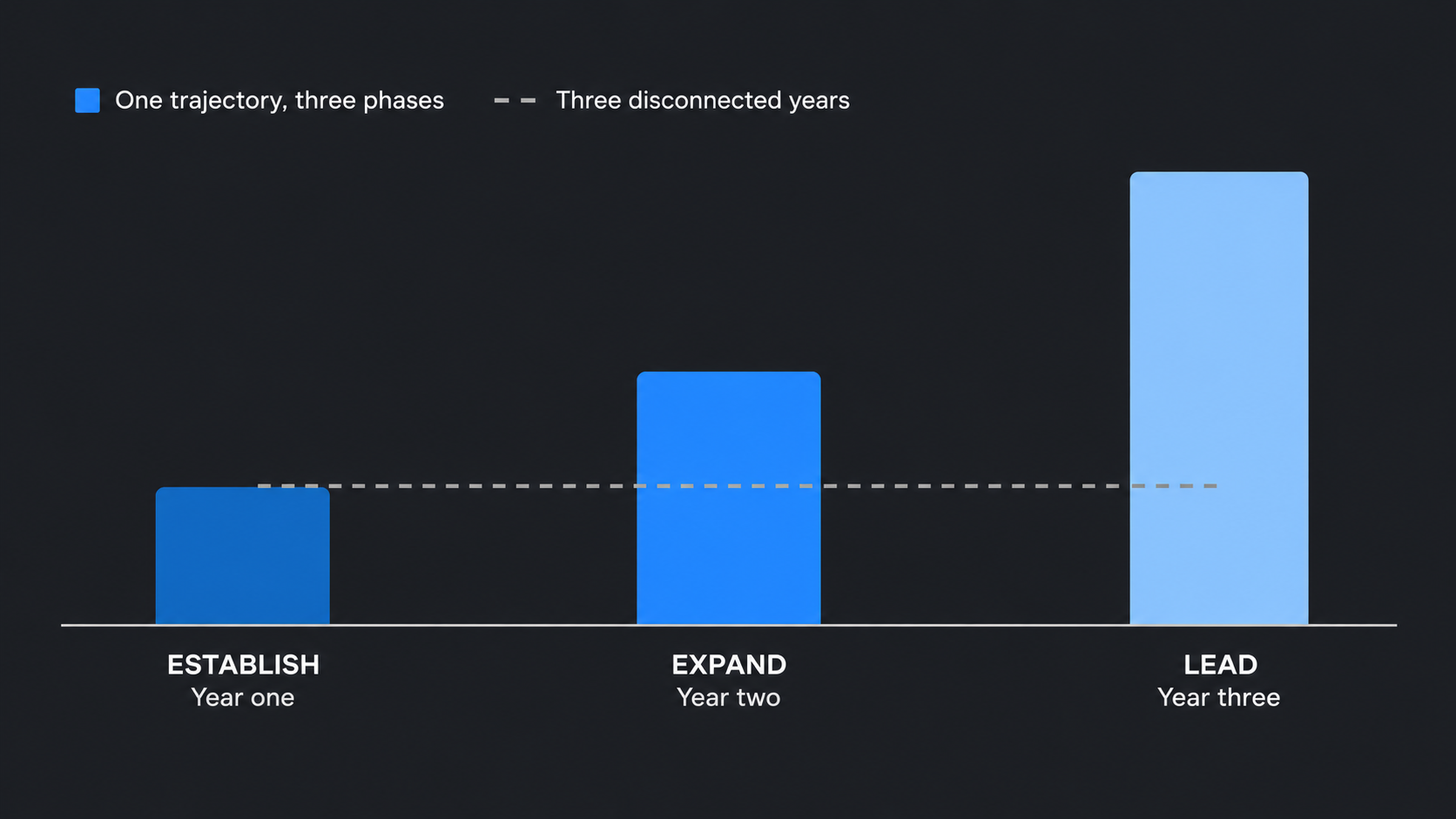
Establish
Year one proves the delivery model, but establishing baseline metrics is key. If you do not measure year one properly and have agreed KPIs, there’s nothing to demonstrate growth against in year two. The conversation about renewal becomes a conversation about opinion, which is almost impossible to quantify. Set the measures before you deliver, agree them with the client, then report against them transparently, irrespective of whether they flatter you or not.
Open analysis at this stage is essential, as some things almost certainly won’t have worked and that also must be recognised. A programme that survives year one without anything being abandoned has probably not been examined honestly.
Expand
Year two scales what worked, introduces formats the client was not ready for in year one, then deepens the relationship beyond the original point of contact.
The discipline here is subtraction as much as addition. Every programme accumulates activity that continues because it continued last time. Year two is when you kill some of it, which is considerably harder than adding, because somebody somewhere is fond of it.
Expansion also means widening the internal footprint. A relationship that lives with one stakeholder ends when that stakeholder moves. A relationship embedded across marketing, communications, operations and senior leadership survives a change of personnel, which is the most common way good partnerships end.
Lead
Year three cements the client as the authority in their space. Note the important caveat: not the agency. The legacy belongs to the client. Any framework that quietly positions the agency as the hero of year three has misunderstood what it is for. The agency’s reward for getting a client to industry leadership is that leading becomes expensive to walk away from.
Leadership in practice means the programme starts producing its own gravity: partners approaching them, speakers wanting the platform, competitors responding to their calendar. The measure is whether the market has started organising itself around what the client does.
What this does to the budget conversation
Framed across three years, budget stops being a cost conversation.
Year one carries setup that years two and three do not repeat. Research, platform build, supplier onboarding, the learning curve. Presented as a single-year number, that looks expensive. Presented across a trajectory, it’s amortised, so the per-year figure tells a different story. You are not asking a client to spend more money, you’re showing them how spending now reduces the cost of doing the same thing later.
Continuous improvement belongs here as a principle instead of a line item. The moment it becomes a line item, it becomes negotiable and often the first thing cut.
Transparent accountability
Multi-year thinking has an obvious failure mode. It can become a way of deferring accountability, where a disappointing year one gets excused as foundation-laying and year two as building momentum.
So each phase has to stand on its own. Year one must deliver something the client would have been satisfied with had it been the only year. The trajectory is what makes it worth more, never what makes a weak year acceptable.
The other risk is presumption. A three-year framework in a proposal can read as an agency awarding itself a three-year contract nobody offered. The framing matters: this is what the client's ambition requires, here is the shape of it, whoever delivers it.
Why legacy frameworks matter for all stakeholders
Warren Buffett once observed that, "Someone is sitting in the shade today because someone planted a tree a long time ago."
What can make us uncomfortable about this is knowing that the person who plants the tree may never get to sit in the shade. Multi-year planning asks both sides to accept some version of this: the client commits beyond the horizon they can see, the agency invests ahead of the revenue.
So, if the brief only asks for year one, why answer a question nobody posed? Because it changes how the response is read. Two proposals arrive. One answers the brief precisely. The other also answers the brief precisely, then shows what year one makes possible, what year two builds, where the client could be by year three.
The second approach demonstrates that you have understood the business, not just the document. Almost nobody in that room is thinking only about twelve months. The client has a longer ambition they did not write down, because the brief was not the place for it. Showing the trajectory tells them you were listening to the thing they did not say.
What you get in return is the only thing worth having in this business, which is not a renewed contract, though that follows. It’s a programme that still exists after the people who built it have moved on, doing something that the client could not have done in year one, for an audience that now expects it.
That’s legacy. It’s not a word to put in a proposal, it’s what is left when you have gone.