Evil Twin Theory: what is the other, identical you doing right now?
Somewhere out there is an evil version of you.
Same skills. Same contacts. Same start in life. A slightly better haircut, possibly a twisty moustache, definitely better lighting. This person wants everything you want, is going after it right now, plus has one major advantage that you don’t have: they are not embarrassed about any of it.
If that person were actively trying to beat you to your own goals, what would they be doing today that you are not?
Get out of memories
In 1985, Intel was losing the memory chip business it had invented. Andy Grove, then president, was in a room with co-founder Gordon Moore, going round the same argument they had been having for months. Grove asked him what a new chief executive would do if the board threw them both out tomorrow.
Moore answered immediately: they would get out of memories. Grove suggested they walk out of the door themselves, come back in, then do exactly that. Intel exited the market that had defined it, moved to microprocessors and reshaped an entire industry.
The decision was not the hard part: both men already knew the answer. What they lacked was permission to act on something their own identity was blocking.
Inventing a stranger gave it to them. The evil twin is a permission device.
Futurethink CEO Lisa Bodell built a workshop on the same principle, asking teams to adopt their main competitor's mindset and work out how they would put their own company out of business. Groups that could not name a single weakness in a normal strategy session produce a devastating list within twenty minutes. Nothing changes except who is asking.
Stop apologising for what you want
Psychologists Hazel Markus and Paula Nurius described how we hold mental images of who we might become. Hoped-for selves and feared selves both work as motivators, giving concrete form to drives we otherwise leave vague.
The evil twin is the self who wants what you want and has stopped apologising for wanting it.
In Jungian terms, the shadow holds everything we refuse to recognise in ourselves. It’s easy to assume that this means the ugly material, but psychotherapist Robert A. Johnson argued that the opposite is harder, that people resist the noble aspects of their shadow more strenuously than they hide the dark sides. Owning the gold there, he said, is terrifying.
Study your evil twin's behaviour again with that in mind. They move quickly, speak up about their work, guard their time, treat failure as information. None of that is bad or wrong. You have simply labelled it that way, because calling it arrogance is more comfortable than admitting it’s readily available to you.
The Evil Twin Playbook ™
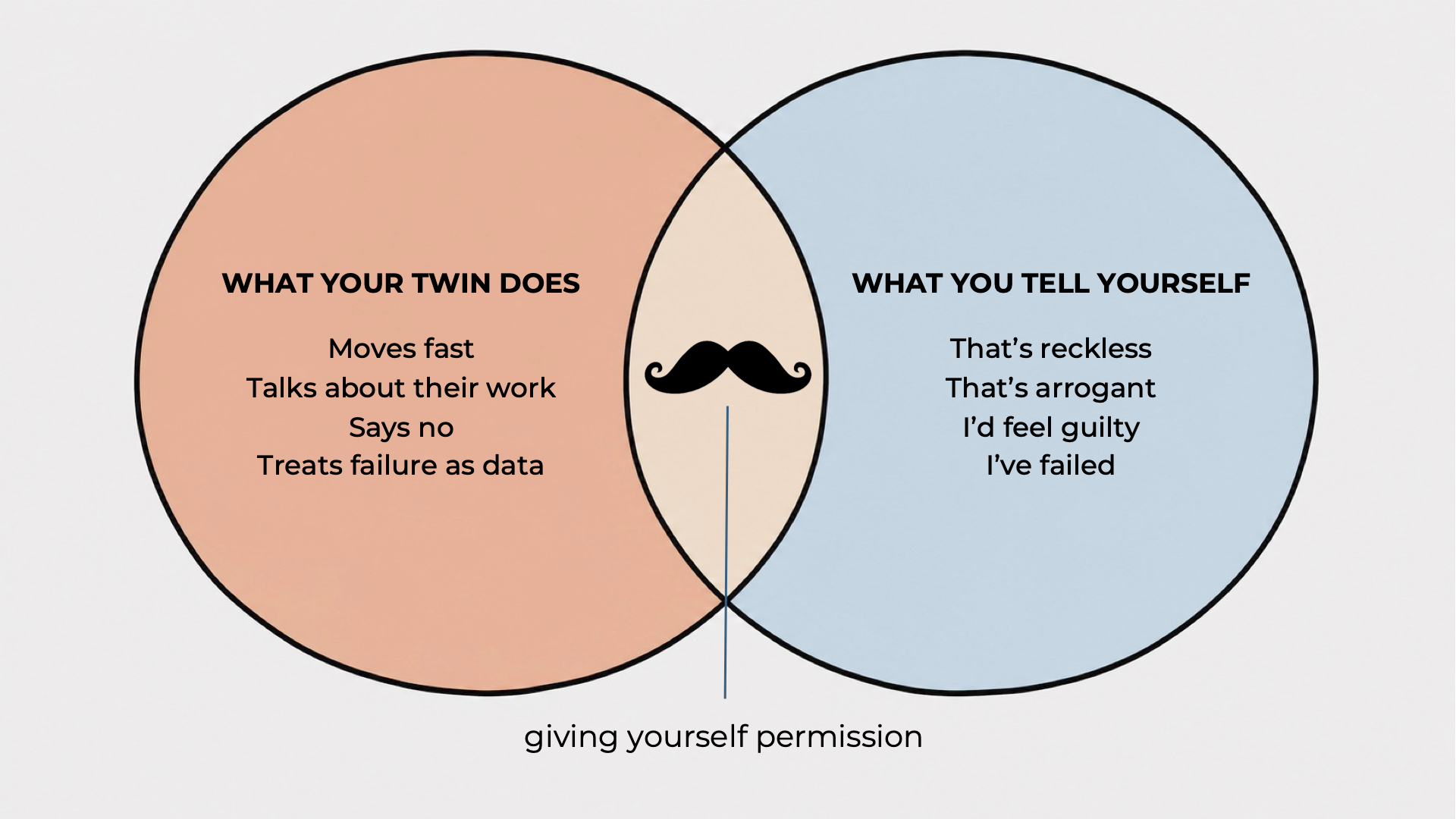
They move before they feel ready. No waiting for the right moment, no rehearsing the email for two days. They launch, ask, apply. MVP mindset, straight to market. Not because they are certain, because they have noticed that looking foolish costs almost nothing while waiting costs everything. Trade perfectionism for momentum.
They talk about their work. Loudly, without the throat-clearing. Quiet competence gets overlooked with remarkable consistency. Modesty performed too well starts to look like an absence of anything worth mentioning. Your work does not announce itself.
They protect their time without guilt. Being evil, they find no is a complete sentence. Every yes to a low-value request is a slow no to the thing you actually said mattered, delivered in instalments so small you never notice the transaction.
They treat failure as data. No spiral, no story about what it proves. Something did not work, so they look at why and adjust. Setbacks are information about a method, never a verdict on a person.
Good artists borrow, great artists steal
You are not being asked to abandon your ethics. Your evil twin's advantage was never moral flexibility. It’s that they have granted themselves permission you are still waiting for somebody else to hand you.
That permission is the only real difference between you and your twin. Everything else, the skills, the network, the track record, is identical, because it’s the same person.
So run the exercise properly, as an audit. What would they say yes to that you have been circling for months? What would they have already sent? Whose door would they knock on this afternoon? What would they finally stop doing?
Write the list down and look at how little of it is actually objectionable.
Then walk out of the door, come back inside and be that person.