The sweet spot between want and need
Every experience has three stakeholders with three different agendas. The client wants outcomes: visibility, deals signed, positive press. The audience wants value: content worth their time, connections worth their travel, something worth talking about afterwards. The agency wants to win: the pitch, the delivery and ideally the repeat business.
All three parties believe they know what they want. Very few of them can articulate what they actually need. The gap between those two things is where most experiences fall short and where the best proposals find their edge.
The Blind Spots
In 1955, psychologists Joseph Luft and Harrington Ingham developed the Johari Window, a framework for mapping self-awareness across four quadrants: what is known to you and others, what is hidden, what is unknown and most relevant here, what is known to others but not to you. The blind spot.
Research cited by Harvard Business Review found that only 10-15% of people are genuinely self-aware. Applied to organisations making decisions about experiences, that number is likely worse. Clients have blind spots about their audiences. Agencies have blind spots about client priorities. Audiences have blind spots about what it took to put them in that room. The proposals that win are the ones that map these blind spots deliberately, not the ones that respond to the brief as though every party sees the same picture.
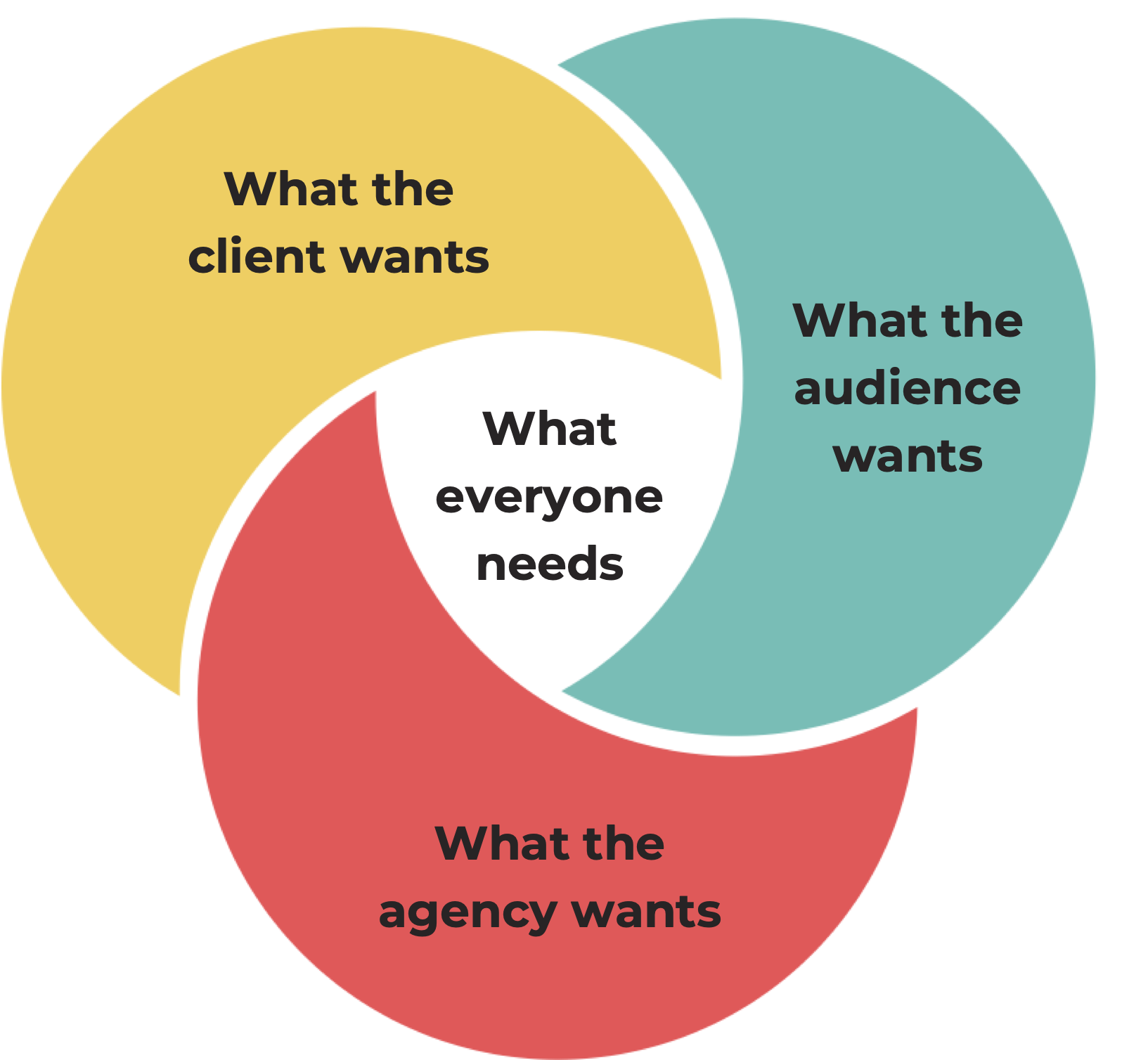
This is where a simple framework helps. Think of three overlapping circles: what the client wants, what the audience wants and what the agency wants. The centre, where all three converge, is what everyone needs. That is the sweet spot. It is also, typically, the gap in most proposals.
What the Client Cannot See
Clients write briefs that describe what they want: a world-class experience, strong attendance, measurable outcomes, positive media coverage. These are legitimate objectives. But briefs rarely articulate the gap between aspiration and reality.
Is this a repeat event? If so, what is the baseline? What worked last year and what quietly failed? If it is a new event, what assumptions are being made about audience behaviour that have not been tested? The client’s vision and goals sit in their open quadrant: visible to them and to you. The blind spot is the distance between those goals and the conditions required to achieve them. MOUs will only be signed if the right people are in the right rooms with the right facilitation. Positive word of mouth will only happen if the experience is worth remarking on. Success outcomes depend on decisions the client may not have considered yet.
The agency that identifies these gaps in the proposal, without being adversarial about it, is the one that demonstrates genuine understanding. Not just of the brief, but of the problem underneath it.
What the Audience Will Not Forgive
Every attendee at an experience is making an investment, even when the event is free. There are flights, hotels, time away from the office, opportunity cost. For B2B events in particular, the calculation is simple: was this worth my time?
Seth Godin built his entire “Purple Cow” philosophy around a single observation: the word “remarkable” literally means worth making a remark about. An experience that delivers on its programme but fails to be remarkable will not generate the word of mouth, referrals or early re-registration that the client actually needs. It will be attended, evaluated as “fine” and quietly forgotten.
Networking is almost always the number one priority for attendees, especially at B2B events. Yet it is one of the most consistently deprioritised elements in delivery. Networking is almost always sold as a headline feature in pre-event marketing comms. Then the event app has a basic directory with no matchmaking, the physical spaces have no structured facilitation and attendees are left to hope they bump into the right person during a coffee break. The audience’s blind spot is that they assume the client has prioritised their experience. The client’s blind spot is assuming the programme alone delivers it.
What the Agency Avoids Saying
The agency’s blind spots in a pitch are often the most commercially sensitive and the least discussed.
RFPs can be extraordinarily vague in critical areas. Even a 100-page brief can be light on budget guidance, ambiguous on evaluation criteria or silent on what the client considers added value versus scope creep. The importance of clarification questions cannot be overstated, particularly around budget. In the Middle East, government and institutional clients rarely provide budget parameters in the RFP. This creates a guessing game that is familiar to every agency working in the region.
There is also a tension that most agencies navigate silently: is this a genuine opportunity or a costing exercise? With new clients, especially where procurement teams require three or more responses to every RFP before award, there is always a risk that the incumbent is secure and the additional bids are serving a benchmarking function. If the incumbent is strong, the client may be looking to validate existing pricing rather than genuinely evaluate alternatives. Managing this reality requires judgement; acknowledging it in a proposal requires care.
Added value is another blind spot. Agencies know that going beyond the stated scope often differentiates between winning and losing. It demonstrates that you understand the client, that you see the gap between want and need. But added value, especially when it comes at cost, is rarely approved in delivery. The proposal promises the moon; the contract funds the streetlight. The agencies that handle this well are explicit about what is included in scope and what is a strategic recommendation for future phases, rather than blurring the two.
And when a pitch is lost, particularly in procurement-driven processes, feedback is rare. Did you lose on design, budget, strategy or something else entirely? Without that data, the learning cycle is broken. The agency’s blind spot about its own weaknesses persists, unchallenged.
Finding the Centre
The sweet spot is not a compromise. It is not the place where each party gets a portion of what they wanted. It is the place where clarity replaces assumption. Where the client’s objectives are pressure-tested against audience reality. Where the audience experience is designed with commercial outcomes in mind. Where the agency’s response demonstrates that it sees all three perspectives, not just the one the brief describes.
The proposals that find this centre do something specific: they name the blind spots without blame, present a view (flexible but firm until proven wrong, as a former boss of mine used to say) and show the client that what everyone needs is more valuable than what any single party wants.
How do you identify the blind spots in a brief? And how do you address them without overstepping?