Merriam-Webster’s 2025 Word of the Year was “slop”: low-quality digital content mass-produced by artificial intelligence. A Pangram study published this month, scanning over one million posts across five platforms, found that 41% of long-form LinkedIn content is now AI-generated. LinkedIn itself has responded by building systems to suppress generic AI posts, with VP of Product Laura Lorenzetti describing an “AI solving AI” approach to separate original thinking from content that lacks substance.
The sheer, screaming irony to one side, the discourse around the prevalence of “AI slop” is everywhere; notably, of course, around (and about) content on LinkedIn. The conversation is framed as AI versus human. The strawman assumption is that AI is the problem and human-written content is the standard we should return to.
Heads up, buttercup. LinkedIn was chock full of slop long before generative AI existed: human slop.
Human Slop Was Here First
Scroll through LinkedIn in 2019 (if you dare). The “I’m humbled to announce” posts. The three-adjective leadership platitudes. The engagement-bait stories that never happened. The thought leadership that contained no thought and offered no leadership. The carousel posts that restated the obvious across ten slides. None of that was AI-generated. All of it was slop.
Human slop is content created without original thinking, without genuine expertise, without a point of view worth defending. It existed at enormous scale before anyone had access to LLMs. What AI did was make it faster, cheaper and easier to produce. It didn’t invent the problem – it removed the friction that previously limited how much of it could be published.
The mass-proposed solution, “write it yourself instead of using AI”, misses the point entirely. If the human input is vague, generic or derivative, the output will be too, regardless of whether a model generated it. Weak inputs get weak outputs. Open questions lead to open answers. Weak strategy produces weak content. The quality of what comes out is determined by the quality of what goes in. Breaking news: what goes in is always generated by a human.
Slop + Slop = Slop
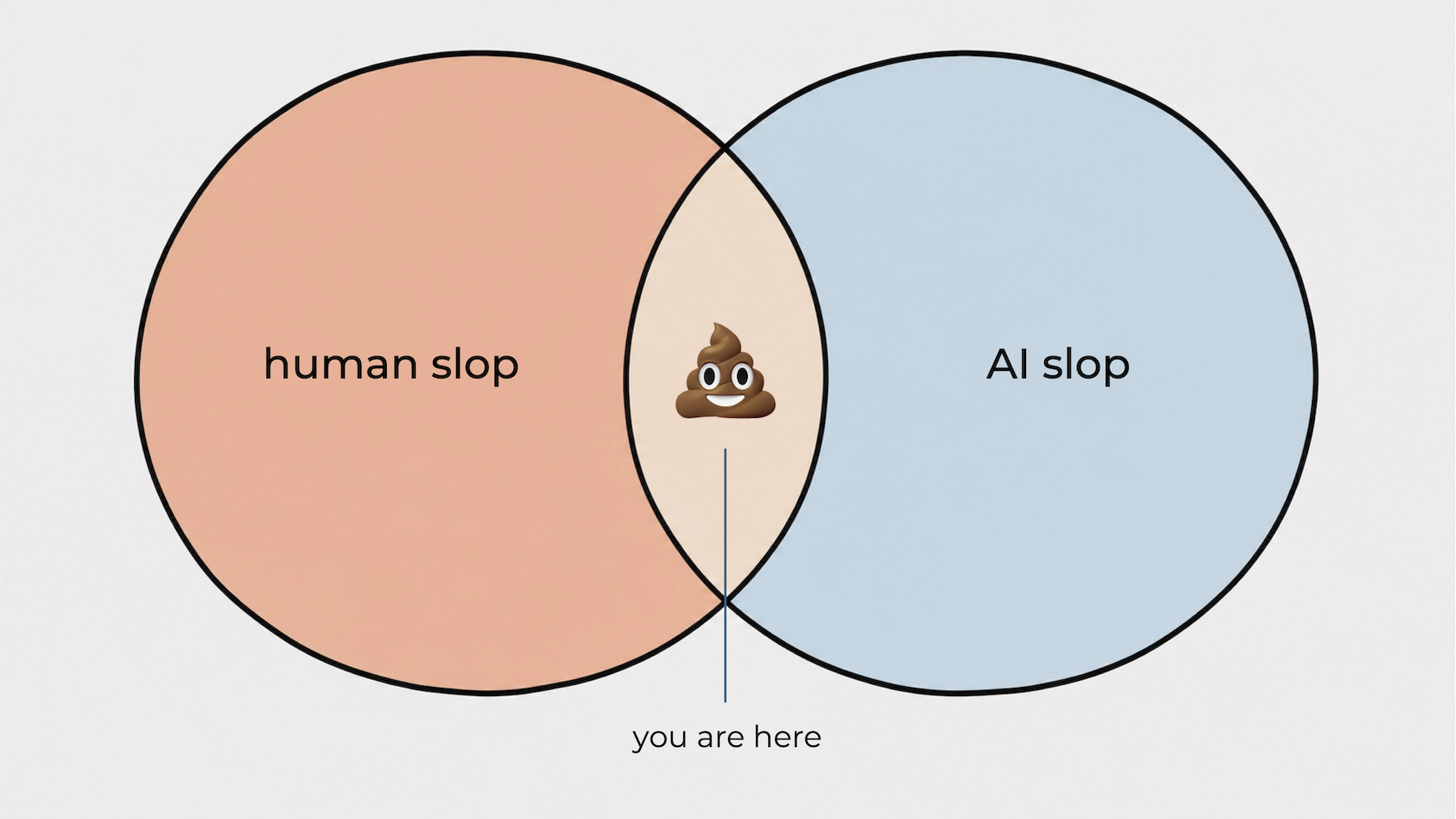
This venn is a diagnostic. When AI capabilities (data processing, pattern recognition, scalable content generation) are combined with weak human input (no original thinking, no expertise, no editorial standards), the overlap is predictable: slop at scale. The AI amplifies whatever it receives. If it receives nothing worth amplifying, the output is noise with better grammar.
This isn’t an argument against AI. The opposite, actually. It’s an argument for raising the standard of the human contribution. The model is not the bottleneck. The prompt, the strategy, the thinking that precedes the prompt: that is where quality lives or dies.
What It Looks Like When It Works
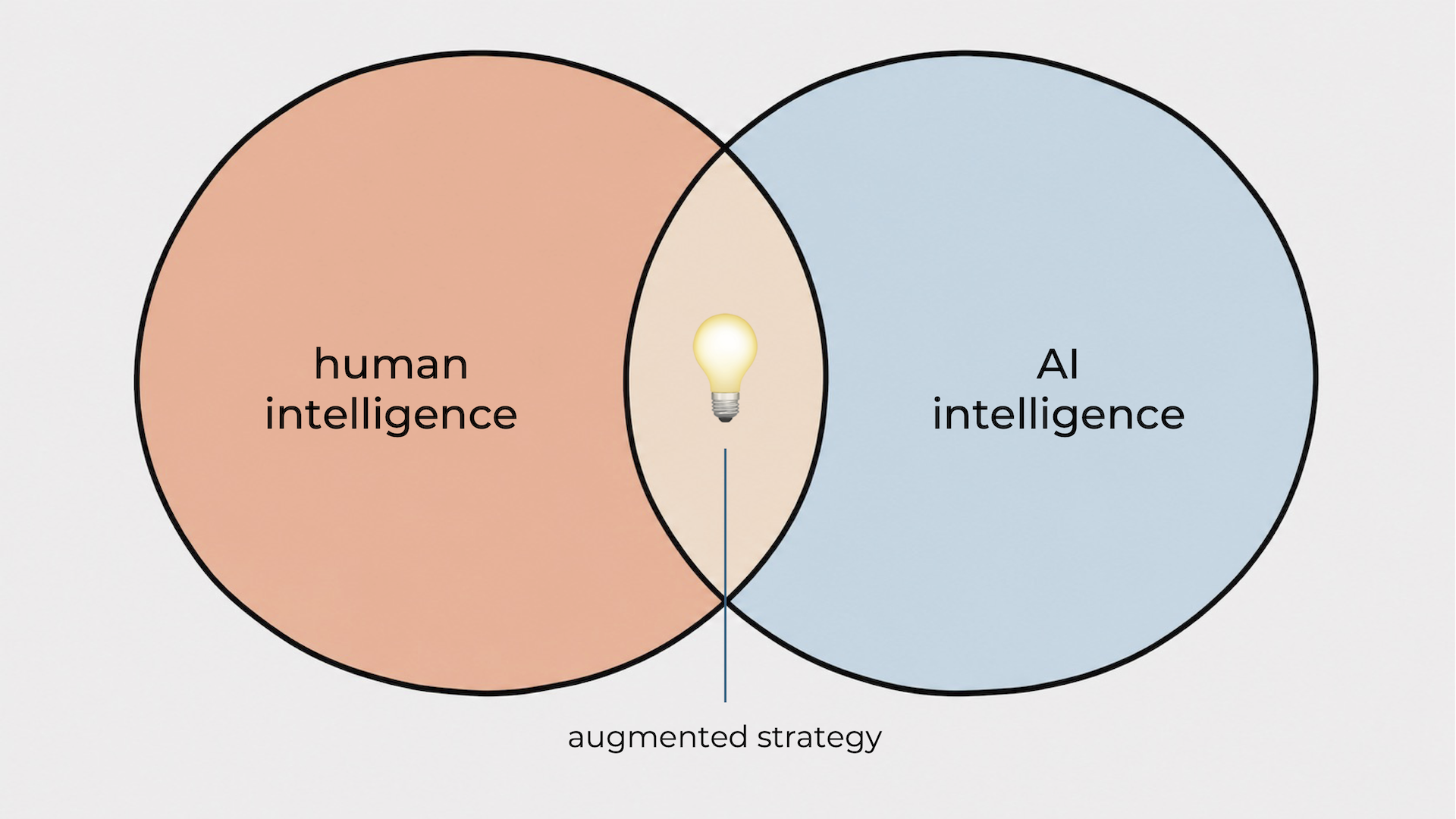
Now this venn is a prescription. AI brings capabilities that humans cannot match at scale: processing vast datasets, identifying patterns across thousands of data points, generating and iterating content at speed. Humans bring capabilities that AI cannot (currently) replicate: empathy, moral reasoning, lived experience, contextual judgement, the ability to construct an original idea from nothing.
The overlap, the collaborative space, is where the value sits. Ideation where the human provides the strategic direction and the model rapidly expands on it. Research where AI summarises and drafts while the human fact-checks and refines. Decision-making where human context and empathy combine with AI’s analytical capability to produce outcomes neither could achieve alone.
In practice, this means the human does the hard work first. The learned point of view that comes before the prompt. The lived experience, the understanding of audience, the judgement about what matters and what does not: these are the inputs that determine whether the output is worth publishing. AI does not generate original thought (or, at least, should not be relied upon to do so): it processes and structures the insight that the human brought to the conversation.
The discipline has not changed. It’s the same discipline that produced good work before AI existed: have a clear point of view, do the research, think before you publish and edit ruthlessly. AI accelerates every stage of that process. It does not replace any of it.
The Standard Was Always the Same
Your LinkedIn feed in 2026 is full of AI slop. It was also full of human slop in 2022 and all the pre-AI years before that. The common factor is not the tool: this isn’t AI’s “fault”. It’s the absence of original thinking coupled with the unwillingness to verify and edit – or the expertise to do so – force-multiplied by the belief that publishing volume matters more than publishing quality.
AI did not lower the bar. It revealed where the bar already was, which would comfortably set a new limbo world record.
Creators who use AI well are the same folks who created well before it existed: clear thinkers who use these tools to amplify their expertise, as opposed to a substitute for it. The creators producing slop with AI are, overwhelmingly, the same folks who were producing slop without it.
The tools may have changed. The standards have not.